
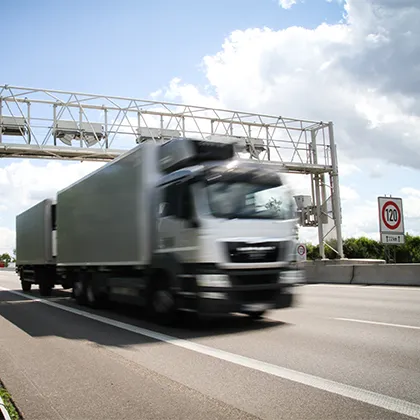
Easy processing of compliance requests thanks to AI
LogisticsAI
Read how cronn simplified the processing of compliance requests for Toll Collect with an AI-based solution.
Reference
Our customer:
As Germany’s third-largest airport, Berlin Brandenburg Airport (BER) connects the capital region with 155 destinations in 55 countries. 26 million passengers used BER as a central mobility hub for national and international air travel in 2025.
Longer waiting times aren’t uncommon at airport security checkpoints, especially at peak times during high season. To monitor these waiting times, there are sensors at the security control lines at BER in Terminals 1 and 2 that record the number of passengers in real time. An incorrect passenger volume to available control line ratio is an indicator for waiting times. Depending on how long the measured waiting time is, a new line can then be opened.
Passengers at BER Airport can now use 24 control lanes with new CT scanners. Longer waiting times are considered exceptions, for which causes must nevertheless be found. Until recently, this time-consuming research was carried out manually. To counteract this, a data-driven and automated root cause analysis was to be developed.
The problem: The security check and the associated waiting times are influenced by numerous factors that are distributed across different data sources. However, the quality and completeness of the data set are crucial, as the machine learning model must recognize patterns and correlations from the existing data. BER also has a very complex data landscape with high data intervals and, as a digitized airport, already collects a large amount of data that made the project possible in the first place.
In order to explain cases with higher waiting times (high wait incidents) and to identify reliable patterns, cronn built a machine learning setup. The first assumption was that if high wait incidents can be predicted with AI, then the causes can also be named.
The data set comprised airport measurements from May to December 2025 and it included predicted and real waiting times, throughput and the number of open control lanes. However, it turned out that the data was not sufficient to identify any reliable rules. This was mainly due to the fact that high wait incidents rarely appeared in the data set and that an entire security area had to be temporarily closed. No clear pattern could be defined: the exact same conditions sometimes led to queues, but sometimes they did not.
Although it was not possible to make any concrete statements about the causes of prolonged waiting times, this first approach provided enormous added value for BER. When analyzing the question of why the machine learning approach was unable to formulate reliable rules, we came across gaps in data quality. For the first time, the airport received a tangible, reliable statement about the quality of their data.
Instead of AI-supported root cause analysis, the focus shifted to automatic case-by-case diagnosis by the Siko Sense explainer, which detects high wait incidents. To do this, it continuously compares real-time data from the last hour with values which would have been expected under normal circumstances. BER can transfer the results to any dashboard via an interface. In addition, management automatically receives an e-mail report once a day, including the most important influencing factors. It shows all incidents of the day at a glance, separated by terminal, and illustrates with simple bar charts which specific factors led to the waiting times.


The automated analysis of possible waiting time events by the Siko Sense explainer reduces manual effort and creates transparency about the influencing factors. The model structure enables us to highlight events quickly, in a standardized and data-based manner.
The previously manual and therefore error-prone analysis of the influencing factors has been fully automated. This has reduced the workload from hours to a few seconds. Instead of having to work with delayed information, the Siko Sense explainer now generates an automatic report every morning, which interested parties at BER receive daily in their e-mail inbox. This provides a standardised and reproducible analysis of waiting times, which previously had to be painstakingly created by hand.
The strategic added value of the entire project lies in an area that was a blind spot before: data quality. As the initial, in-depth data analysis with machine learning has already shown, problems in data collection no longer go undetected. For the first time, these findings gave the airport a fact-based basis for targeting service providers about unreliable sensors or faulty interfaces. Where there was no improvement roadmap before, this approach resulted in a concrete action plan. The airport now knows exactly where the database needs to be optimized, while the Siko Sense explainer helps to keep an eye on inconsistencies during ongoing operations.
This approach solved two core problems at once: the Siko-Sense explainer eases an enormous operational burden in everyday life, while the preceding ML analysis lays the strategic foundation for continuously improving data quality.

Read how cronn simplified the processing of compliance requests for Toll Collect with an AI-based solution.

Read how cronn and North Data GmbH expanded their system with an AI solution.

Read how cronn automated processes in its core business for billyard.